Wednesday, April 13, 2011

Cultura de la Primavera: Springtime Fiestas

Sevilla lives for fiestas. Disfrutate en Sevilla.
Especially this time of year.

Andalucia is preparing as well speak for a fiesta (Okay I really really love that link's video, which I know is a beer ad, but it encapsulates everything about Andalucian culture in a simple video. Sorry if you can't understand it. Learn Spanish? I don't know what to tell you).

Anyway, next week will be Semana Santa, or Holy Week, which will bring a ton of religious processions through the city streets and even more festivities that include yummy dulces, or desserts! Consuelo made homemade torrijas a few days ago and it's been hard for me to not steal them from the cupboard when she's out of the house. So good!

Festivities begin on Palm Sunday, fraternities or brotherhoods will lead processions throughout the streets and thousands of people will gather to witness the passing of these men carrying large golden sculptures of different Saints and Jesus Christ. These brotherhoods have been practicing carrying these extremely heavy wooden "floats," for lack of a better word, for weeks. Consuelo's son-and-law will be participating in one of the processions.

Very Catholic. Very crowded. Very excited to witness this world-famous celebration!


I'm going to Germany (Wittenberg and Berlin!) on Friday until next Wednesday, but I will be back for the most celebrated days: Thursday, Friday, and Saturday. Then of course there is Easter, in which I will probably attend Mass at the Cathedral. Impresionante.

That takes place every Spring called La Feria de Abril. Feria will be the first week of May this year and I don't really know anything about it other than:

1) There is Flamenco music, including singing, dancing, and guitar playing. (I also added a video from La Carboneria, a bar in Sevilla that has live Flamenco shows nightly.
2) There is Flamenco dress. Called trajes de Flamenca, all the girls and young women wear these weighty, ruffly, and colorful dresses, even in the 90+ degree heat of Andalucia.
3) There is eating.
4) There is drinking.
5) There is hot weather. (Which arrived already...)

This year Feria is May 2-9. I'm going to Rome (!!!!) on the 2nd until the 7th, so I will be here for two days and nights of Feria. I imagined that Feria would be something witnessed from afar, playing the gringa clad in Old Navy and flipflops standing back and watching the Andalusian culture.

Just for the fun of it, a friend and I went to a store to try on some trajes. Because I didn't want to miss out on something so important to Sevilla, I had to at least try a dress. People take these dresses very seriously here (the cheapest I've seen have been 160 euros, these were 190...!).
So, of course, I had to see what the fuss was all about...


I really had a good time pretending to be a Sevillana. I even contemplated buying the dress (until I saw the price) to use in the future: for Halloween, for teaching Spanish culture, for Fiestas of my own, for when I miss Sevilla, etc.

We put the dressed back on the racks and giggled our way out of the store.

I thought the fun was over.
Then Kelly and I got an email about someone selling really cheap second-hand Flamenco dresses...

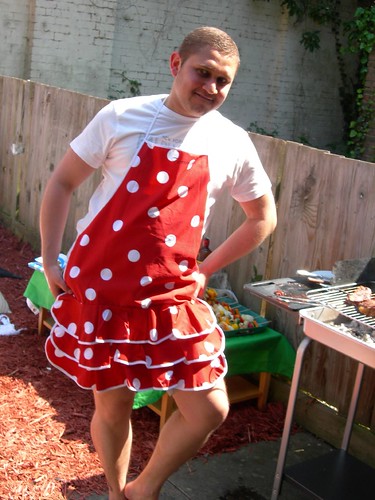
This post is to tell you about my newest (and largest and heaviest and most clown-like) Sevillana souvenir:

Rosa con lunares.
(Kelly's is green with stripes and very guapa as well. More pictures later, perhaps during Feria?)

I hope you like it :)
And I hope I have room in my suitcase.
If not, I'll just wear it on the plane back..!

Sunday, April 10, 2011

Vida de Reflecciones


Tonight, as I bite into a dark chocolate covered shortbread cookie that some Germans kindly made for me (yeah, these "Zartbitters" are as good as they sound), I silently castigate myself for my not so nice break from writing for these last couple weeks.

Sorry about that.

Regardless of the pause in my electronic word-flow, there was much Spanish being spoken and much life lived. A lot of that has to do with the fact that spring's turned into summer and the orange trees are in bloom.

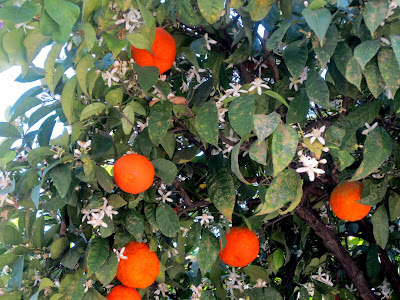
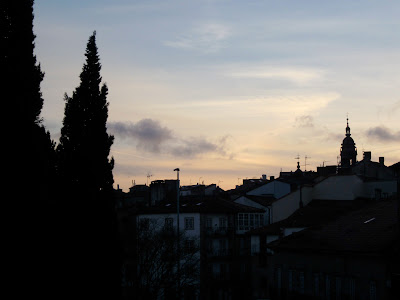
I cannot describe the sweet-freshness of the aroma of Sevilla's orange tree blossoms. The whole city faintly smells of the azahar white flower. The breeze carries this scent through the stretched-thin streets, passed all the building whose colorfully painted tiles glimmer in the sunsets. It does not overpower, only adds beauty to this already remarkable Andalucian city. A city I like to call home, even though I only have a month left within it's barrio of Triana.


What a menagerie this semester has become.
To describe what has been going on here, I'll try to make a little collage of words and stories and algo así in this blog. It may just become a list. I'm sorry if it does. A list would make these last few weeks seem dull. And dull they have not been.

For starters, I went to Lisbon, Portugal. It was nice. But it's not Spain. And for that, me faltaba algo.

I really do enjoy a good day in Spain. Sevilla, like I said, has been beautiful. I got to experience it in a different way on the 3rd of April, when I ran in the Carrera Popular y Escolar Triana.
Basically, there is a wonderful path along the Río Guadalquivir that I have grown accustomed to running about every other day for miles on end. Along this path you can find roller-bladers (It's cool to roller-blade in Europe, I don't understand it), Bicis (bicycles), the occasional khaki-clad-backpack-wearing tourists, men running in spandex shorts, and finally American college girls. We get a lot of stares from the gente, let me tell you. After a couple of months here, I heard about the City's monthly 10 k races, or Carreras, and thought: Well, I might as well do something with all this ridiculous cadio stamina I've been building up because I like looking at the pretty river sparkling in the sun (most of my reason for running, I'll be honest). So, with the help of my friend Pablo, I figured out how to register for the race. Then, on April 3rd, I ran the 10.7 km race with a bunch of Spanish men! You can see from the results that there were other women in my gender/age group, but not many. We ran around the Los Remedios and Triana neighborhoods of the city all morning, finishing about an hour later to receive free t-shirts, granola bars, water, and, of course, Cruzcampo for all!

There were more days passed in Andalucia. During which, Consuelo's son, wife, 2 1/2 year old, and newborn, all of whom live in China, came to visit and stay with us...for a month.
They are muy guay, I love the toddler, Lucas, especially. Once he figures out sentence structures a little bit more, he'll speak English, Spanish, Chinese, and American Sign Language
Yeah.
I'm jealous too.
Right now his speech is a mix of vocabulary and phrases from these four languages (English from TV and movies, Spanish and ASL from his home-life, and Chinese from school). It's the cutest. It really is. He also speaks technology (operating his Dad's I-phone and I-pad solo, to play Vocabulary, spelling, and games with ducks in them). We share a common love for the movie Toy Story and the pass-time of misconjugating verbs.

Luca's dad works in China at a factory of some Spanish company. He speaks Spanish, English, German, Chinese, and some ASL and Japanese. His wife knows a lot of English and Chinese as well. They are unconventional Spaniards and I love living with them. Many days, I wake up to Luca yelling "Nye-Nye! Nye-Nye!" (Grandma! Grandma!) in gleeful tones, trying to get Consuelo's attention. Emma, the newborn, rarely cries and mostly just sleeps peacefully and beautifully in her mother's arms.

Sevillano life was continued with two very important Andalucian things:
Churros con chocolate and Trajes de Flamenco.
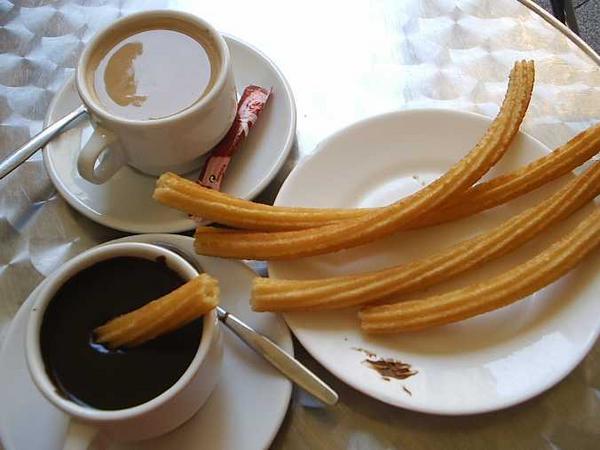
Churros are a typical merienda, or snack, here in Southern Spain.

Kelly and I went to get churros con chocolate one day after a rather dreary day of classes. I'd love to tell you we didn't finish this mountain of fried dough, but that'd be lying.

After that, I decided to go a little more native and dress a little more Sevillana.
Flamenco dresses are typical of the Spring celebration of Feria de Abril, that will occur the first week of May here in Sevilla. Girls and younger women all dress in them during this weeklon celebration of drinking, eating, and Flamenco music. It's kind of a huge deal. Sevillanas take it very seriously. And, of course, so did Christie and I:
Basically, Flamenco dresses are ruffly, eye-catching, voluminous, and heavy. And not to mention expensive (these costing 190 euro...no purchases were made).

This past weekend, I got a break from the heat of Sevilla, and experienced a trip of a lifetime.

I travelled to País Vasco, saw the Guggenheim Museum, and didn't get killed by ETA terrorists. Basically, it was muy guay.

My Favorite works of the weekend were by artists like Mary Cassat, Chillada, Grís, and Gaugin.
Above all, I loved the Guggenheim Museum building, itself. Frank Gehry. American ingenuity. Spanish, Seattle-like city (on account of all the creativity, greenery, urbanity, and rain--without the coffee I'm afraid). This city is off the typical tourist's path, but is growing in popularity, especially in the Art world. I travelled with my interest group Arte y Sus Raices, basically my Art club from the CIEE study-abroad program, to have a jolly good time in Northern Spain, looking at works of art that once lived in only in my dreams.

Life goal #46- complete-

The audacity and vitality in art makes life seem so tangible and seeable.
I can reach out boldly to pick it right off of some big tree and eat it when it's ripest, only to be left feeling satisfied. But not completely so, because there's more, and there will always be more, because there always can be more.
It's yours to discover.

I think that is the way we're supposed to feel after seeing man-made creations.
But I'm not sure.
Maybe, looking at a work of art is like watching a child mimic its father. Draw a tree almost makes a tree, but not quite. Not at all. But almost sometimes.
Art reflects life. Artists reflect God.
Only a reflection, an 'almost' that shows a relationship. Just as a child cannot be its father, but can learn to show his same kindness or graciousness.
We see so much and experience worlds within worlds.
Infinity can never be known, and yet there are incalculable things within each of our lives, no matter where we live.
It is impossible to tell you all about the worlds within my life. Or show you all of what I've seen.
But I try and will try, because I must.
See beauty and reflect it.

Friendship is unnecessary, like philosophy, like art... It has no survival value; rather it is one of those things that give value to survival.
C. S. Lewis

Through the wall of my bedroom, I can hear Consuelo talking to her sister on the phone while she lies in bed. It's nice to be here, where it smells faintly of azahares and there are German cookies and Spanish words and, above all, where I can see a little of what the world holds. God has made it so, so full. We don't need a TARDIS to see universes (although, granted, I'd still leave to travel in the blue-box without a second thought).

I only have about another month here left. Above all, with this last month, I hope that life will be lived and more world will be seen. Reflections of the creator in the creation around me. I'll keep running along the river, speaking Spanish to those who will listen, and explore by travelling a bit more.

Wittenberg and Berlin, Germany, on April 15th.
Rome, Italy, on May 2nd.
United States of America, May 14th.

There is much more, as always. And I am ready to see it, hold onto it, and continue to reflect it to everyone else.

Thursday, March 24, 2011

Living “Spanish” for the Sower:

I have had SO MUCH STUFF going on lately...


Some of the awesome stuff:

-My family visited me!

-They brought me peanut butter!

-I got to see Barcelona Futbol Club play Sevilla!

-I bought three dresses!

-Consuelo made Gazpacho!

-I'm going to Portugal this weekend


Some of the not awesome stuff:

-I got a pretty bad cold last week, including a nice little fever (I blame Consuelo's germs for this one).

-I have had midterms last week, this week, and next week.


For that reason, mainly, I have not been able to blog lately.


BUT- here is a guest column that I have written for The Sower, Concordia's Student Newspaper. Some of it you all will have heard about, some perhaps not. Anyway...Enjoy:


Living "Spanish"


This semester I have vacated my Ruth C suite to study thousands of miles away from Concordia, in Seville, Spain. I had been planning to study abroad ever since I submitted the paper to my advisor, that sold my soul to the Education Department, with the word “Spanish” scribbled in as one of my concentrations.

When I arrived in Spain, that was still just a word on a piece of paper, tucked neatly in a filing cabinet. However, because I am living here, I have had to adopt that tiny word into a whole lifestyle.

All of the sudden my life did not revolve around going to TLEC, to Chapel, to Janzow, Repeat; it revolved around...Spanish. And let me tell you something: there’s nothing like throwing yourself into a homogenized, foreign culture to show you that you really don’t know that much Spanish.

I remember when I got picked up by my host-mom, my Señora, Consuelo. After a week of orientation, I had seen presentations and been on tours of the city, all led by the CIEE (Counsel on International Education Exchange) Study Abroad Program staff. Although all of that had been in Spanish, I hadn’t had many one-on-one encounters with Spaniards. Now I would be meeting the woman with whom I would be living for the next five months of my life. Let the communication confusion begin.

Most Spaniards know a little English, especially the younger generations. Consuelo basically knows one word in English: “table.” However, she half the time she forgets the word’s meaning and will just repeat it until she remembers, or until I finally point to the table to end the strange, furniture-inspired chanting. Needless to say, we communicate in Spanish.

When I met her, we had exchanged a greeting of besitos, or those European, cheek-kisses (yes, people really do those). Then we started with some small-talk in the taxi. That’s where the humbling experience that has been this semester began.

Although I’ve studied Spanish since eighth grade, it has been a little challenging actually living “Spanish.” Within five minutes in that taxi ride, I managed to confuse the entire conversation by mixing up the number fifty with fifteen. I remember Consuelo had a confused expression on her face, but I didn’t realize my mistake until a week or so later. We laugh about the silly mistake now, at least I think that’s what we’re laughing about when we reminisces about that day... I could be confused still.

Language is like liquid inside our minds, sloshing back and forth to change forms at any instant. It’s difficult to control this stream of consciousness and make it bend to fit a specific paradigm, in my case Spanish. However, difficulty is almost always worth the momentary trouble. Vale la pena, as they say here.

Seville makes me think of beautiful words like río (river) and sueño (dream). I still think about the expanse of the Nebraskan sky at dawn, but this semester has been an amazing adventure of words and experiences. I have fallen in love with a city of orange trees and its beautiful language. Of course, I continue to make grammatical mistakes and I’m clearly a foreigner here, but I almost feel like its all becoming my own. I hope that others at Concordia, who have similar dreams, will go through all the tedious planning and have their own language adventure. It is worth it. Vale la pena.

Saturday, March 12, 2011

Photo Update: Mira, mi escuela-


Thanks to Kelly's audacious photographing, I now have this picture of my University classroom to show you all!
Please notice the rocks protruding through the drywall, including Oklahoma and Idaho in the upper right. (Makes me think of you, Erin!)

I know, it's a pretty snazzy place.
Well, the rest of the building is more impressive, with courtyards and fountains. This is just the room they stick the foreign kids in to learn the difference between la cura and el cura.

Friday, March 11, 2011

It's all about the food:


I eat pretty well here.
Correction: I eat really well here.
Better than Janzow, for sure.

New exciting places means new exciting food!

One of my favorite things about traveling this semester has been sampling the typical cuisine of the region. The Spanish, especially here in Andalucia, eat a basic Mediterranean Diet.
And so do I.

Here's the breakdown:

mediterranean-diet-food-pyramid1.jpg

This pyramid that I stole off google images pretty much describes my diet here, with the except of chocolate and sweets (which Consuelo never gives me. I guess that is healthier. But I have been able to eat some with the help of friends' packages and M.A.S.).

Coma, conmigo hoy:
Eat with me for the day:

8:30-9:00am
El Desayuno: Breakfast
tostada (pan); zumo de melocotón y uvas; cafe: toast (fresh, white bread from a bakery down the street), peach-grape juice (love it), and coffee.

(It was hard for me to get used to eating so much white bread. I'm a whole wheat kind of girl. But it is sooooo good.)

2:00-2:30pm
El Almuerzo: Lunch
Dos-tres platos y picos o pan y fruta. Two-three dishes, with picos (served at lunch and dinner) or bread, and fruit for dessert.

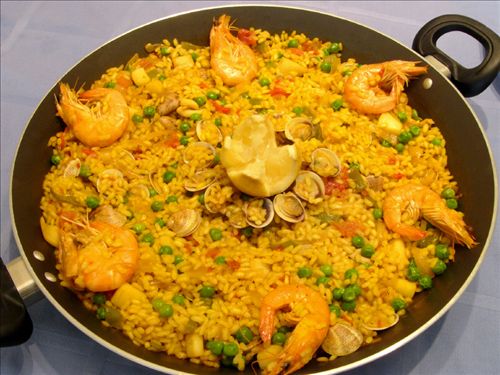
Everyday I eat some kind of hot food made with olive oil. Always made with olive oil. Aceite de oliva. It could be any of combination of the following: bean/pea/carrot soup or a potatoes/onion dish or paella con mariscos or chicken or bacalao (cod) or tortilla española(hecho con patatas o carne o atún - made with potatoes or ham or tuna. Nothing like Mexican tortillas, more like an omelet).
I love Spanish tortilla...

Also, for lunch to go:
Un bocadillo (a sub made with white baguettes or bread and ham with lettuce and tomato, or tortilla in between two pieces of bread--carb central! but I love it) with two pieces of fruit. The lucky kids get nutella bocadillos (I'm not lucky).

4:00-5:00pm
Cafe por la tarde.
Coffee in the afternoon.
A lot of Spanish people drink some coffee as a pick-me-up after their siestas. I do quite often, regardless of whether or not I take a siesta (usually don't). Consuelo usually goes to meet her friends at a cafeteria (coffee shop) that serves free churros con chocolate with coffee.
Or, you can go out for a snack like this:
Cafe con leche (espresso with milk), té (tea), gofres con chocolate y nata (waffle with chocolate and whipped cream), cafe solo (espresso) y una napolitana de chocolate (chocolate filled flaky pastry wonderfulness).

5:30-7:00pm
Tengo Hambre: The Hunger Game Begins:
Everyday I start to feel really hunger around the "normal" hours of an American Dinner. Usually I sneak a merienda, or snack, from my secret stash in my room of things like dark chocolate, cereal, granola bars, and peanut butter (very expensive to buy peanut butter here!). Don't tell Consuelo about the stash. I don't think she's found it yet.

Two days a week, I have my Culture and Cuisine: The Gastronomy of Spain class (yes, I get three credits to learn all about food!) during this time (5-6:30pm).
We sit around talking about food for an hour and a half while my stomach growls. I really love this class because I am learning so much about Spanish culture and great vocabulary.

Also... There are days when we get to have una cata, or a food tasting! These catas make this class basically into a snack sesh. So far, we've had two catas:

Cata #1:
Aceite de Oliva: Olive Oil
My favorite kind was made with Hojiblancas, a type of aceituna (olive).
Olive oil is a staple here. Consuelo uses it in EVERY SINGLE DISH SHE MAKES. Probably even fruit salads. She doesn't even tell me that it is in a dish, if I ask for a recipe, because it's just assumed. But I like it.
Cata #2:
Los dulces españoles: Spanish Desserts,
Traditionally made during Christmas time and Holy Week:

White stuff: Sultanas de Coco (just egg whites, sugar, coconut!) Very simple, very good! Like really soft macaroons. (****)
Middle thing: Torrijas. Very sweet. Traditionally made around Holy Week. Tasted like I was eating French Toast soaked in a pool of liquidy honey. (**)
Tin-foiled pastry: Pestiños. Complicated to make, traditionally done twice a year in large quantities when all the women of the family get together and make them. Kind of tasted like a nutty, fried, sugary pie-crust twisted into a fun shape. (***)
Plastic-wrapped, powdered sugar covered thing: Roscos de Vino. Made around Christmas, in the oven, not fried. They are hard, dough-nut shaped cinnamon rings, covered in powdered sugar. Very good for dunking in coffee. I really want to make them sometime--My favorite from the cata! (*****)

9:15-9:30pm
La Cena: Dinner
Sopa de calabacin y patátas, y quizás, una tortilla o pollo o pescado. Postre de fruta.
Usually just one or two dishes. Consuelo makes a weekly-supply of soup, made of pureed zuccinni and potatoes (and olive oil of course), which we eat with some picos or bread. I actually really, really love it. Even though it looked like this!
Typically, we also have either a tortilla or some fried bacalao or chicken. This meal is smaller, right before bed. Followed by a piece of fruit.

If you go out to a restuarant, you can find a bunch of options, especially of fried seafood, examples in the photo below, which was taken when my friend Beth and her mom visited me last week!
We ate at Bar Bistec in Triana, near my apartment:
Pollo frito (fried chicken bites), montadito de bistec (tiny sandwich the Spanish can't do steak. Trust me), Rioja Crianza (Andalusian red wine), Bacalao frito (fried cod), and picos andpatatas fritas (french fries).

Overall, I really enjoy the Mediterranean diet. If you don't like seafood or olive oil or bread, then you probably couldn't survive here. In the next couple of months, I'm excited to try some more different kinds of foods, especially the pastries! I'm also going to bring home some recipes to continue eating some of these dishes back in the States. Consuelo has taught me how to make the tortillas and some of the soups.

So. . . Anyone want to come over to my house for some Spanish food next year?
I'll buy some olive oil, put on some tunes and my Flamenco-styled apron, and we'll be good to go!

Wednesday, March 2, 2011

Mira, mi escuela-

File:Universidad de Sevilla (rectorado) 001.jpg

I go to school in this old Tobacco Factory.

I have three of my four classes at the Universidad de Sevilla. These are classes with other extranjeros or international students, but the Spaniards come to this Old Tobacco Factory as well for their studies.

Building's Brief History acc. to Wikipedia:
"Built in the 18th century, Seville's tobacco factory was the largest industrial building in the world at that time and it remained a tobacco factory until the 1950s. This beautiful building is also the setting for the very well-known opera by Bizet, Carmen. Carmen was a fictional worker in the tobacco factory, the original story being a novella by Prosper Mérimée Prosper Mérimée. This building houses two of the university's faculties: the School of Literature & Philology and the School of Geography & History."

This building is superguay.
Every time I go to class, I feel like I'm entering a museum or a castle of some sort. It's so odd to see students smoking in the courtyards, folders and notebooks in hand, or stopping at the espresso vending machines before class, because they just got back from a night of botellóning three hours ago.

I haven't ever stopped to take pictures yet.
I'm not sure I want to be that girl.
(Even though I stand out enough with my North Face backpack, light hair, and Target clothes...Oh, and mediocre language skills).

I only have a couple Spanish friends, and most of them don't have classes in the same facultades (Philology and History) as I. Last time we got together, they told me about the new changes in their University system. It's a lot different to be in college here. You take tests during high school and then enter into a facultad, kind of like a major. You then only have classes within that facultad and there is really no freedom to, for example, take a random drama class if you are in the History and Geography facultad. Then they complete their studies in about 5 years.

My friend Manú envied the fact that I can take whatever courses I choose and change my major if I want (if only). Manú also explained to me that the European Union is kind of making an international change to their countries' University systems, more or less nationalizing them, for lack of a better word. I'm skeptical. Their Universities are a lot cheaper than ours though. But so far, I have noticed a difference in...quality.
Side note: Manú also told me that in Spanish high schools, clubs, school-sponsored sports, and all other extracurriculars don't really exist. (Weird huh? What do kids do if they aren't skipping off to lacross practice then cello lessons then SAT training?)
Another side note: Manú is in the Philology facultad, studying English. He has to read Moby Dick this semester! (Pray for him...)

I think that they just kind of stick the foreign kids with the left-over classrooms and professors.
Maybe that sounds rude.
But there's a rock the shape of Oklahoma growing out the wall in my Advanced Grammar classroom.
To get to that aula, or classroom, I have to walk to the corner of this huge stone building, ascend a large marble staircase, walk down three corridors into the dimly lit bowels of the Factory, find the door marked "Aulas XIII & AIV", go through the door and up the rickety staircase on the right. I'm always surprised when I don't end up in some old Abuelita's attic, but instead in aula XIII for Grammar.

Like I said, the yellow-painted dry wall of the room is kind of built around the original stone, Factory walls. There is a blackboard smacked onto this wall as well, which my professors uses to over explain minute details of grammar (this class is somewhat like Studies of the English Language, at Concordia, except less organized and in Spanish). There are five or six foot-long spots on this yellow wall in which the stones have protruded out into the room.

During class, I try to memorize words like sintagma while really imagining that one of the rocks looks like a three-legged elefante.

Or dreaming about my future trips to Germany and Rome.

Sunday, February 27, 2011

Galicia: A Different Kind of Spain

"¿Pues...Dónde estamos?
Where the heck are we?"

These were the first words I heard my friend, Christie, sputter on the early morning she, Kelly and I stepped out of the A Coruña airport to embark on our first solo trip of the semester.

Palm trees.
Fog.
Ocean cliffs.
Forest-covered hills.
Tall, fair-skinned, soft-eyed and kind-souled people.
Sing-song celtic-Italian sounding Spanish language?

Were we still Spain?

Simply put, I knew nothing about Galicia before I landed in the northern province. Okay, I knew there was a Cathedral, famous with pilgrims as the resting place of Saint James. I also knew that the weather and landscape were more akin to Ireland than my Sunny Sevilla. When researching study abroad programs, I had originally tried to find a program in Santiago de Compostela because of the advice from a relative and my University advisor.
As a result, the location was also in the back of my mind as somewhere I wanted to visit in the future. So, in January, when Kelly asked me if I was interested in making this trip during our first long weekend, I bought a ticket, booked the hostel, and said ha-lueo to Consuelo.
(That's Hasta Luego in an Andaluz accent, by the way).

When we finally got to Galicia, the three of us meandered through the city of A Coruña until we arrived at the end of our Spanish world. This site of the northwestern region of the Iberian Peninsula meets the ocean in rocky cliffs and green sloping grasses, as well as holds the oldest farro (light house) in Europe.
The fog had cleared, but we were still wondering at the strangeness of Galicia. Especially when someone nearby began to play the bag-pipes (gaitas). Laughing out loud by this point, we had no idea where the heck we were. However, I was not complaining at all.

After much photography near the glacial-blue waves, we boarded a train for our final destination. I, of course, pretended I was Hermione Granger the whole time. However, I only saw Galacian (gallego) commuters and university students and no one came by with a trolly full of sweets. The journey was still fun, though.
And beautiful.

Taxi, Plane, Bus, Train...
Finally, we had arrived in Santiago de Compostela, Galicia, Spain.

I could sense a strange hint of Spain in the air, but the landscape and the people didn't seem like the I Spain I have come to know in Andulucia.

The landscape:

Spain+Seattle weather+Irish hills+forests of green=Galicia

The city of Santiago is green and white and stone and lovely. The large windows, seen on the building on the right, are unique to this area of Spain.

The people:

I love love love love their accents.
They speak Castellano (Spanish) but a little more slowly and almost like they are singing, an influence from this region's historical Gallego dialect. (As opposed to the Sevillano accents I fight to understand daily). I tried to mimic it as much as I could while I was there, talking with the people. But I think I'll just have to move there someday to really get the hang of it.

They look like Christie.
Christie, left, with one of her Gallega sisters, right.
Taller, paler skinn, lighter hair, richer brown eyes, or sometimes even blue. To add to the strangeness of our adventure, we seemed to be in a land full of my friend, Christie's, relatives. (She has somewhat distinctive features that make people at a loss for her ethnicity sometimes. As a Mexican-American, her ancestors came over from a different part of Northern Spain, so it really a little like we had come to her homeland).

Their souls shine in their voices.
What is more, these Spaniards were a lot kinder than their Southern countrymen.
I also found them marvelous to photograph, especially at the market.

I loved this woman. She sold us cake of Santiago and a wonderful pan de pasos (raisin wheat bread) and even some advice about men, which was free.
Pig heads, cheese, conversation were present at many stands at this market.
Grains and beans and flour in this panderia. I think Galicia has the best bread in Spain.

The sights:

We were lucky enough to have found a fantastic hostel near the center of Santiago de Compostela. And even more lucky, we knew a girl, Molly, who lives and teaches English in the city, and basically acted as our personal tour guide for the weekend! (She is from the same college as my relative who suggested Santiago for my studies! Small world, Midwest!) She showed us some beautiful parks and a museum with this amazing staircase and the Cathedral!

Cool picture, right?! I don't know how it happened!

The Cathedral:
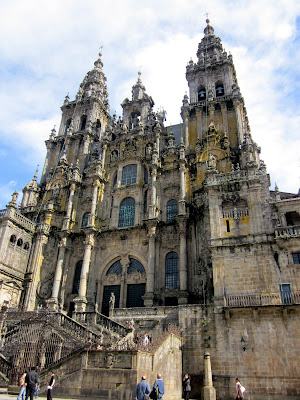
This trip originated with my friend Kelly's undying desire to travel, like the pilgrims, to the Cathedral of Santiago. Last semester, after researching and completing her 15 page Medieval Christianity paper over this sight, she was beyond excited. I loved the mossy stone walls of this magnificent building.
People have traveled to this sight for centuries, only to glimpse the tomb of Santiago (St. James) and light a candle, which you can even do via text messaging, if you really can't make the journey, and hug some golden statue. (Not even going to expound on my opinion of that... I'll just say that this is a very Catholic country).

I enjoyed seeing this place, but I hate going to a church feeling like a tourist. But we are his children whether we are sight-seeing, traveling, praying, eating, sleeping, learning, dancing, running, walking, or dreaming. In that fact and in the Resurrection of Christ, I take comfort.


Galacian food:

Food, the best part of traveling? I'd say so. When we were hungry and looking for some authentic Gellagan food, Molly hooked us upppppp.
Cafe solo y pan con pasos, y las noticias. Coffee and Raisin wheat bread.

Gambas con aceite y ajo. Shrimp in olive oil and garlic.
Patatas y pulpo. Potatoes and octopus. Pulpo is SO GOOD. I think I probably ate about 6 of the 8 legs this guy originally had.

Texture of these got me (Erin, take note). Though, I did try one.
Seafood is very typical to Galicia. Most all of the bars give out free tapas with drinks as well, usually cheese and types of pork or tortilla or types of seafood.

(Want to know a secret? Molly even let us use her kitchen to make a little Mexican food from the ingredients we bought at the market. Glorious Guacamole! It did help that Christie did most of the cooking...)

Even with the Mexican food, this trip had a distinct Galician flavor. I loved the people and the green rain and the slow pace of this city. It reminded me of a very small, very Spanish Seattle without Starbukcs. In comparison to Sevilla, Santiago de Compostela is a more relaxed city of the North.

Where ever I travel, it seems that small-town, northern people are a lot more lax about style. Not many people in Santiago seemed to care that I was wearing a hooded sweatshirt and jeans, where as in Sevilla it isn't appropriate attire for a Saturday night out. In Santiago, we got a kick out of the fact that the bars and cafes played classic rock or 70's disco music, not Lady Gaga or Justice Beaver.
Free tapas tell many tales about the character of a people. (Granada, another wonderful city, had free tapas, too). In Santiago, the air is misty-different and many people sing hola to each other as they pass, even to us Americans who don't have a clue. I feel like this place is a secret that the world hasn't discovered. You should visit there, too.
As we left to return to the airport, by train, I heard a woman's cell phone ringtone alert her that she had a call. It was a gaita ringtone of some traditional Gellaga música. A last little bit of Galician culture before our journey back to the land of Flamenco.

Every time I travel to a new place, I see myself living there. And it looks wonderful.
As for now, I am home in Sevilla and excited to be back in my city of warm orange color and the river. But I think there may be something Gallego in my future. Yes, indeed, I hope so.